The Development of Battersea
Sean Creighton, - January 2005
The history of Battersea's built environment is fascinating: the public buildings, streets, houses, shops, leisure facilities, open spaces, railways and roads are interesting. Concern about the built environment must include concern about the effect changes to it have on people, because it only exists so that people can live, work and move around. Whatever part of Battersea you live in your neighbourhood has been evolving and been shaped through a continual process of interaction between local needs and aspirations, local and national, and sometimes international political and economic power.
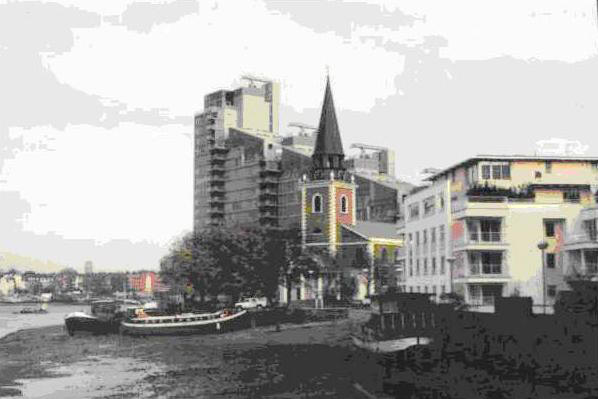
This photograph epitomises the 250 years of change in Battersea. On the one hand the building of Montevetro can be seen an extreme example of the way economic and political processes interact to change the built environment of every community in this country, trampling over the wishes of local residents and politicians. On the other hand it can be argued that the fight against Montevetro was lost back in the 1980s when the local politicians approved a policy for riverfront heights that enabled stepping up from one scheme to another.
Monevetro is the result of modern planning law. Seemingly there to mediate conflicts of interest, that law is not neutral. It is determined by the predominant political view at the time through the legislation and through local political interpretations. It is determined by the fact that different interest groups have different levels of influence. The least influential are ordinary residents acting by themselves. Organising together in groups like Battersea Society can from time to time have some influence. This is of course a political point - but not a party political point.
The building environment we inherit is not the product of some past neutral process, it has been created by similar processes to those underway today.
Historic Battersea
Leaving aside minor changes Battersea has boundaries over the last 250 years were set by the Church, sand then became political administrative boundaries. The Thames to Clapham Common, from Wix's Lane to Wandsworth Common, plus the part that formed a wedge down south to Balham.
As you go around Battersea what would you say are its main features.
Battersea Park
Wandsworth Common
Clapham Common
The Railway Network
Doddington Estate
Battersea Park Rd/York Rd
Lavender Hill/St Johns Hill
Queenstown Rd
Battersea Power Station
Shaftesbury Park Estate
Battersea Town Hall
Latchmere Baths
Battersea and Albert Bridges
St. Mary's Church
I am sure you can add more. Obviously the Montevetro project will become one.
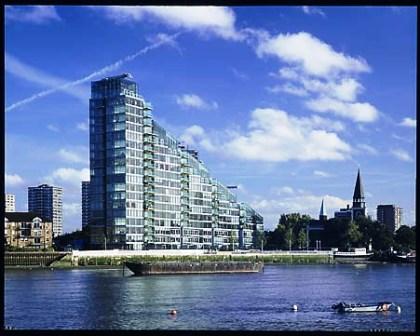
These details (left and below) with permission from the web site ARCAID
On this excellent site you will find more Montevetro photographs both exterior and interior.
Copyright © Photographer: Richard Bryant
Architect: Richard Rogers/Hurley Robertson
Montevetro , Battersea , London , SW11
View from across river with barge Modern block of flats glass steel stepped riverside exterior lifts exterior lift shafts terracotta tiles terracotta cladding Chelsea power station.
Montevetro is the literal translation from Italian of Glass Mountain (Monte - Mountain and Vetro - Glass
I wish to give you a feel for the way Battersea has changed over the last two hundred and fifty years.
St. Mary's Church
Back in the 17th and 18th Centuries St Mary's serves a large Parish. Most of its residents live in the Village near the riverside, winding along Battersea High St and up to the Church. The Church is re-built in 1775-77. It becomes a fashionable Church supported by people like William Wilberforce when he lived on Battersea Rise. William Blake married the daughter of a local market gardener in it.
But Anglicanism is not the only religion supported by local residents. There was the Battersea Chapel on York Road.
Battersea Bridge
Because Battersea did not have a bridge until 1771 it was a sleepy rural village on and near the North-east Surrey shore of the Thames. The Lord of the Manor decides to build a bridge, and it opens on 28 November 1771 to pedestrians and vehicles in 1772. The bridge opens up Battersea as a Surrey riverside parish for the well-to-do of London to have out of town houses, especially around Clapham Common. The Bridge was later re-built and opened in May 1890.
The Economy
The main economic activity is farming and market gardening, servicing London's need for food. One of the by-products of the produce processed at the Horizontal Mill is feed for cattle on their way to the London.
A smattering of other industries develops, mainly along the riverfront, linked to boats, transporting goods by river, processing foodstuffs and milling.
By the early 1800s Battersea's riverfront has sufficient industrial development for Isambard Brunel's father Marc to set up a factory to make boots for the English armies. His leak proof boots help Wellington to win the Battle of Waterloo.
One of the most important companies to move in is Prices Candles. Its candles light Britain and other parts of the world. Its workers set up the local retail co-operative movement, out of which grew the Co-op Permanent Building Society, now Nationwide, and the Workers Education Association.
Battersea Fields and Park
To the east of the Village is a large area of farm and marshland called Battersea Fields. The riverside stretch is used by Londoners as an out of town leisure area, especially by lovers. Drinking and pigeon shooting takes place at the Red House.
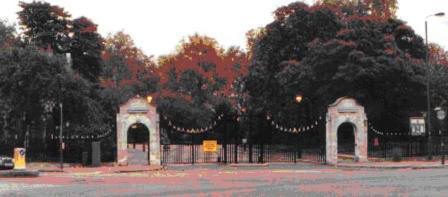
Battersea Park Gates
Wellington fights a dual in the Fields. Campaigning to suppress vice, the Vicar and the local Church establishment seek to end these uses of the Fields. A deal is struck under which Thomas Cubbitt, the Victorian builder, becomes a major landowner in the Fields, and with the aid of an Act of Parliament in 1846 constructs the Park which opened in 1858, and housing around it. Later the mansion blocks of today are built. The Park enables the control of leisure activities through park keepers and night-time closure. It becomes a venue for public events. Much later as part of the 1951 Festival of Britain the Pleasure Gardens are laid out.
The Railway Network and Industry
The year is 1838. The Park is not yet in existence. Battersea is slowly developing in population, housing and industrial terms.
1838 sees the completion of the railway line from the South-West in a deep cut through Wandsworth Common, through the area that became Clapham Junction and along to its Nine Elms Terminus, opened the same year.
The Parish finds itself divided in half. The railway is designed to link London with the important port town of Southampton. Nine Elms to the north-east of the parish is the nearest it is allowed to get to London. Later it is given permission to extend to Waterloo. Although not immediate it is to have a much more major effect which turns Battersea into a dense, congested industrial area by 1888.
There are several stages and impacts. As the railway network south of London is developed the competing companies want to get as near London as possible. Additional lines begin to feed through Battersea. The problem of accessing London leads to co-operation between the companies and a deal with the Duke of Westminster to use his canal basin on the Grosvenor Estate to build Victoria Station. The southern and northern companies co-operate again to develop the West London Extension Line.
And so the Battersea tangle of railway lines develops. Given Battersea has plenty of land that is not built on; the companies begin to develop engineering works and depots.
The new industry employs large numbers of people. So begins a process by which job creation stimulates the building of housing and shops. Subsidiary industries develop as well, also needing workers who need housing. Battersea becomes a specialist area for large scale industrial laundering.
Not only are the farms and market gardens taken over, but the large estates attached to the out-of-town houses, and many of these houses are demolished as well. As well as housing and shops, churches, chapels, schools, pubs and places of entertainment. The latter include the Shakespeare Theatre, Washington Music Hall and The Globe.
Clapham Junction
Clapham Junction itself develops into the busiest interchange station in the country. Inevitably the station stimulates the development of a shopping centre into which comes Arding & Hobbs. There is a constant process of change with businesses moving in, moving out or collapsing.
Wandsworth and Clapham Commons
Battersea has parts of both Commons within its boundaries, Clapham and Wandsworth.
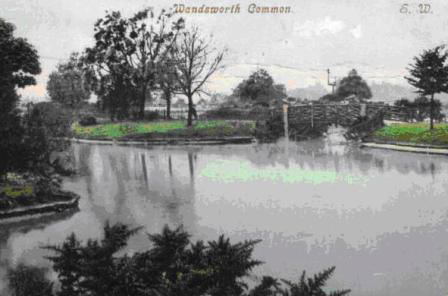
Edwardian Postcard of Wandsworth Common
Much of Wandsworth Common has been eroded through sale to developers by Earl Spencer, the Lord of the Manor. London's Commons only remain with us today because of campaigns in the 1860s against such encroachments culminate in Acts of Parliament in 1871 protecting them. The campaign to save Wandsworth Common involves direct action and mass demonstrations. A prominent leader is John Buckmaster, who grew up as an impoverished agricultural worker's son, became a trained carpenter and joiner, a paid campaigner for the anti-Corn Law League, trained to be a teacher in Battersea, and went on to be a lecturer in arts and culture and education, and a supporter of progressive causes. His son becomes a Cabinet Minister and a Lord.
Shaftesbury Park Estate
One of the new housing estates that is built in the 1870s is not only unusual architecturally, but also socially and politically. It is developed by the Artisans, Dwellings and Labourers Company. Set up by a group of small builders and workmen with limited liability status, it sees itself as part of the co-operative movement. Its aim is to provide healthy housing for working people. It builds low rise houses with gardens and facilities for the estate residents. The better-off workers and clerks are attracted to live on it are politically radical, including the young John Burns. Towards the end of Battersea Park Rd another housing development is built at the same time: Victoria Dwellings. It has tenements, with some sharing toilets. It is several stories high. At the opening the editor of the Times extols the virtues of building up to the sky as the only way to solve the housing problems of the poor.
Radical/Socialist Battersea
The fast expansion of the population, largely workers in the factories and on the railways, is not a political problem for the local middle-class and employer establishment who are politically divided between the Liberals and the Tories, because up to 1885 Battersea is part of the East Surrey constituency, and the restricted voting base means that on the whole they control the Vestry and the Board of Guardians, the twin machineries of local government.
1885 is a critical year in the development of Battersea because new Parliamentary constituencies are created with more workers having the vote. The two political factions have a difficult time re-organising. The Liberal Octavius Morgan, one of the brothers who owns local employer Morgan Crucible, is elected MP.
But in Battersea by 1885 it is too late to weld to both parties large working class support. Battersea's working class has been developing a vibrant and growing multi-faceted culture based on their own organisations, including the Battersea & Wandsworth Co-operative Society, trade union branches, and friendly societies. They have played important roles in the formation of the Amalgamated Society of Carpenters & Joiners in the 1860s, in the formation of the Amalgamated Society of Railway Servants in 1871, and in building the Amalgamated Society of Engineers. In 1885 the radical socialist engineer John Burns sets up the Battersea Social Democratic Federation, and is attracting young and enthusiastic supporters like Tom Mann. Given the context and by astute alliance building with the Liberals and radicals, he is elected as a socialist as Battersea's first London County Councillor at the end of 1888. Four years later he is elected as an independent socialist MP and remains so until 1919. In the same period the local labour movement is instrumental in launching the campaign for the eight hour working day, and in ensuring that May Day is celebrated as a workers holiday. Local activists also campaign for new facilities.
Another two years and 1894 sees the formation of the Trades Council, the Progressive Alliance with the Liberals and Radicals, and electoral victory in the Vestry elections, followed by victory in 1900 for control of the newly formed Battersea Borough Council. Radicals and socialists have already made their impact on the pre-1894 Vestry, especially the decision to build Battersea Town Hall. From 1894 the Alliance pioneers what was called 'municipal socialism' that is the provision of services run by local elected Councillors and Alderman employing officials and workers on fair wages, rather than contractors, aimed at meeting the health, physical, leisure, housing and recreational needs of ordinary people. Battersea earns the title 'Municipal Mecca'. A supporter of the Alliance is elected as the first black Councillor to a controlling political group on a London Council in 1906 and then is elected as Britain's first black Mayor in 1913/14 - John Archer in 1913/14.
And how does the Progressive Alliance change the built environment of the Borough. Among its contributions are:
Latchmere/Burns Estate and the Town Hall flats
A direct building labour depot
A milk sterilising station
An electric power station
Latchmere Baths
During the First War World tensions between the labour and liberal wings break the Alliance up, and from 1919 the Labour Party takes control for most of the time until the merger with Wandsworth in 1964/5. The Labour Party continues the same approach as started by the Progressive Alliance. It is no wonder that when it celebrates its 100th Anniversary in 1994 the Battersea & Wandsworth Trade Union Council titles its historical pamphlet 'Builders of the Borough'. However, the legacy has been tarnished by the high-rise developments from the late 50s which continued into the early 1970s. The rationale for these is caused by one of the most devastating outside forces to affect Battersea: German wartime bombing.
The War and Post-War Housing
With a concentration of industry and because of the railway lines in and out of London, Battersea is heavily bombed.
The post-war Council is faced not only with completely destroyed housing, but housing that needs bomb damage repair. It also faces the deterioration of other parts of the housing stock because it has not been able to give any attention to it during the war years and in the period of reconstruction. The Council faces a mammoth task. It sets about both bomb damage repair and designing new housing. During the 1950s it experiences two twin problems: Government restrictions on Inner London Councils like Battersea building outside their areas, and a subsidy system that encourages estates to be built upwards. And so the solutions chosen are the high-rise estates and blocks through Rollo on the Battersea Park Rd to the Winstanley and York Rd estates to name but a few.
The best known example is the Doddington Estate. The contractors use building systems from abroad but skimp on materials and costs. The contracts are lucrative, and corruption becomes a problem, viz. the Poulson/T. Dan Smith scandals. Caught up in this is Sid Sporle the Labour Councillor who masterminds Battersea's housing programme and continues it after the amalgamation with Wandsworth. He is convicted of being bribed in connection with the Doddington contract. The housing programme is overambitious, so that earmarked for demolition and redevelopment are many other areas of housing which can easily be renovated. The situation is further complicated by the 1960s motorway box plan, which blighted areas like the Louvaine west of Clapham Junction. Many of these areas are subsequently saved from demolition, partly following campaigns, especially those in what became the Louvaine and Garfield housing action areas, and Abercrombie St.
Battersea Power Station and Industrial Decline
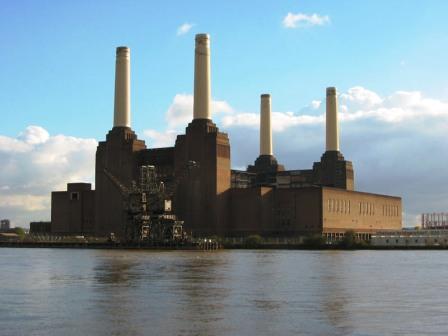
An internationally known symbol of Battersea is the Power Station. Imposed on Battersea by the Central Electricity Generating Board which has taken over local authority electricity power activities and closes Battersea Council's power station in Lombard Rd. For the first period of its life it is only half its size, with two chimneys.
The four chimneys are only completed after the War. It is a major employer. When it closes Battersea is already being hit badly by the decline in industry in general and the contraction of the scale of the railway industry. The lack of space to redevelop, contracting markets, and re-location elsewhere stimulated by regional economic grants, leads to many employers shutting down their operations like Morgans Walk and Gartons Glucose Factory. Although a shadow of its former self Prices Candles remains as a sales venue.
Workers either left Battersea or became unemployed or forced into less skilled and lower pay jobs. With the industrial base in decline, white-collar and public service workers come to the fore in the trade union movement. Many former industrial areas become prime sites for more up-market housing: Morgans Walk and Plantation Wharf being two examples, or are redeveloped for other uses like the Homebase warehouse shop on the old Garton's site. In replacing the former Rank Hovis Flour Mills, the Monevetro development simply continues this trend.
Public Houses
Public houses have been important social centres, and meeting places for working class organisations such as friendly and loan societies and trade unions. But of course not everyone approved of drinking or meeting in pubs. The temperance movement is strong in the 19th and early 20th Centuries. Many of Battersea's leading working class activists are active supporters. One of the drives behind establishing meeting places is to have alternatives to public houses.
Important pubs over the years have included:
The Falcon – re-built c1882-3. Listed in the 1970s as part of the campaign against the wholesale redevelopment of the Clapham Junction Station area.
The Plough
The Nag’s Head
The White Hart
The Old Swan, Battersea Church Rd
The Castle demolished built about 1600, demolished and replaced with a new pub in the 1960s
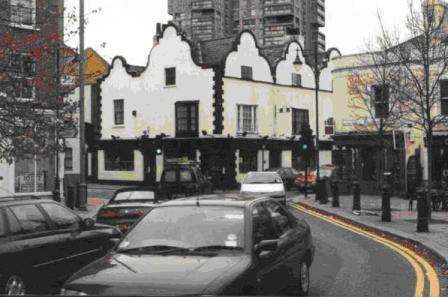
The Raven built late 17th Century
The Raven Public House diagonally with cars
on the north side of Battersea Square
Other Forces for Change
There is no time to go into the other forces for change in the last twenty-five years. These have included:
The decisions of private landlords to sell their properties when their elderly tenants die or move in with their sons and daughters or into retirement homes, are major motor force for the demographic changes called gentrification and Chelseaification of Battersea.
The decisions of the post 1978 Conservative Councils to sell off Council housing and land have added to those demographic changes.
Some of those opposed to Montevetro who live in some of the new housing developments, have probably found themselves working with those who opposed the building of those developments.
Might you be working with Montevetro residents at some stage in the future over the next generation of plans you do not like?
Civic amenity societies like Battersea and Wandsworth Societies are interesting alliances. They bring together Labour, Liberal Democrats, Conservatives, Greens, and non-aligned individuals putting aside Party political differences to influence the processes of change on the built environment. One of the activists in the old Battersea Society was a working class boy who became a leading Battersea Labour Councillor arguing against high-rise estates - Young Jimmy Lane (his father was known as Old). After a long break the formation of the new Society is a welcome development and revival of that tradition.
Sean Creighton
based on a talk to the Battersea Society, edited January 2005