This
section covers
the very early
history and the
setting of the
1939 period.

Hawkley
TO-DAY! by
an evacuee, it
is assumed that
this section
was written on
return to
Battersea as
part of a
school project,
perhaps 1945
vintage?
 The working
people can be
divided into
two groups,
those who can
trace family
association
with Hawkley
(shown left in
2002) through a
number of
generations. In
addition, those
who come into
the district in
search of
better
employment and
who, in most
cases, leave
again. The men
are mostly
engaged in
agriculture
work, but the
women are no
longer employed in
domestic
service; they
are finding
more varied
occupations in
seasonal farm
work especially
that introduced
into the
district by a
successful
market
gardener.
The working
people can be
divided into
two groups,
those who can
trace family
association
with Hawkley
(shown left in
2002) through a
number of
generations. In
addition, those
who come into
the district in
search of
better
employment and
who, in most
cases, leave
again. The men
are mostly
engaged in
agriculture
work, but the
women are no
longer employed in
domestic
service; they
are finding
more varied
occupations in
seasonal farm
work especially
that introduced
into the
district by a
successful
market
gardener.
The village
is too small to
undertake many
social
activities and
although the
Parish Council
has statutory
powers to
demand a
village hall,
it is doubtful
whether the
limited use of
such hall would
justify the
cost of
erection. It is
true the
village has an
 'Institute' but
the
"Queen's
Arms"
(renamed as the
Hawkley Inn)
proves a very
powerful rival.
As most of the
villagers
cultivate
allotments and
produce
sufficient
vegetables to
supply their
families for
the whole year,
they have very
little time
left for social
functions.
During the
summer months
the labourers
work overtime
and no social
activity"
could be
successfully
carried on.
'Institute' but
the
"Queen's
Arms"
(renamed as the
Hawkley Inn)
proves a very
powerful rival.
As most of the
villagers
cultivate
allotments and
produce
sufficient
vegetables to
supply their
families for
the whole year,
they have very
little time
left for social
functions.
During the
summer months
the labourers
work overtime
and no social
activity"
could be
successfully
carried on.
The
introduction
into the
village of the
two modern
amenities
electricity and
main water has
considerably
improved the
otherwise
primitive
housing
conditions.
With two
exceptions the
lack of main
drainage and a
few cottages
where the main
water comes no
nearer than a
pipe outside
the front door.
It is now
possible to
make the
cottages fairly
convenient and
comfortable
although it is
true that the
present high
cost of
electricity
compels most of
the inhabitants
to resort to
oil and coal
for cooking.
The Hawkley
farmers were
quick to
realise the
value of
machinery and
to-day horse
ploughing has
disappeared
entirely. The
few horses that
remain are used
mostly for
equestrian
purposes.
Wartime
compulsion has
changed the
local crops and
pasture has had
to give place
to corn. The
holdings are
small and the
hilly nature of
the district
makes it
impossible to
cultivate much
of the area.
The War
Agricultural
committee has
undertaken the
breaking up of
some fallow
ground and incidentally,
have broken up
several ploughs
in so doing
owing to the
rock like
nature of the
subsoil.
Once a year
the placid calm
of the village
is disturbed by
the influx of
'hoppers'
mainly from
Portsmouth but
including a few
Londoners. Each
year a smaller
amount of hops
is grown and if
this reduction
continues, the
villagers will
be able to cope
with the
picking without
the help of
outsiders. In
the past, this
annual
employment has
been the means
of providing
sufficient
money to set-up
the children
with clothes
for the winter.
The village
shop has been
affected by
changing
economic
condition.
Older
inhabitants can
remember the
time when the
shop supplied
everything for
the village
from meat and
village baked
bread to suits
of clothes.
With the coming
of motor
delivery vans
and the
attraction of
'co-op'
trading, the
village is now
supplied from a
number of
stores.
Since the
regular
Saturday bus
service, the
village has
ceased to be a
place remote
from the
quickened tempo
of modern life.
Even the
children have
to acquire the
travel habit
for at the age
of eleven they
are transferred
to a school at
Liss.
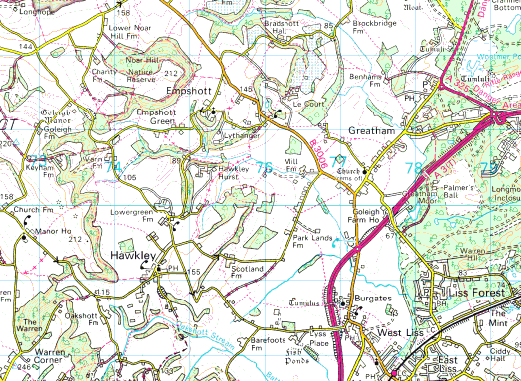
In November
1822 William
Cobbett rode
from Hawkley to
Greatham and
wondered
whether he had
ever seen worse
roads. They are
infinitely
better now of
course but
still narrow,
winding and
often 20 ft or
more below the
top of the
banks on either
side. This was
a little before
the present A 3
(T) road was
built, even in
1939 this road
meandered
through many
small villages
and towns.
In 1774
there was a
huge landslip a
mile east of
the village.
Though part of
a prehistoric
series of
landslips
flanking the
Malmstone
escarpment, it
is the only
recorded
instance of
renewed
movement of one
of these
landslips in
historical
times. Natural
landslips
frequently
occur on the
coastal cliffs
but this is
possibly the
only recorded
case of such a
slip in inland
Hampshire.
Part of the
escarpment
subsided with
deformation and
fissuring of
the ground
below. A
cottage was
almost engulfed
by the
movements; this
cottage, near
Scotland Farm
(see map above),
was rebuilt and
named Slip
Cottage. The
site of the
landslip can be
seen from the
road above the
cottage. The
cause of the
slip was the
sliding of the
Malmstone over
the underlying
Gault Clay
after very
heavy rain in
the preceding
months.
Gilbert
White described
the landslip in
The Natural
History and
Antiquities of
Selborne. He
said that part
of the hanger
at Hawkley fell
down
perpendicularly
in such a way
that a gate
fell 30 or 40
ft and yet
still opened
and closed
perfectly.
According to
White the
length of the
slip was 251
yards, about 50
acres of land
had 'suffered'
and two houses
were entirely
destroyed. The
Hampshire
Chronicle
reported that
60 acres of
land had given
way and a house
was thrown
down. Gilbert
White's nephew
said that
nearly 1,000
people came to
view the scene.
Hawkley Mill
(1774), in 1939
this was part
of the Hawkley
Hurst estate, now a
private house,
stands beside a
tributary of
the river
Rother. It has
an inscription
on the wall:
"Hocheleye
Mill. Ancient
mill of the
Bishops of
Winchester
taken from them
by Sir Adam
Gurdon given
back under King
Edward AD 1280.
Burnt down and
rebuilt 1774.
Became a
cottage 1880.
J.J.M."
Adam de
Gurdon, lord of
the manor of
Selborne and
warden of
Woolmer Forest,
was a follower
of Simon de
Montfort and
fought against
Henry III. He
lost a duel
near Alton with
Prince Edward
(later Edward
1), who spared
his life and
restored his
estates. The
mill here is
probably on the
site of the one
mentioned in
Domesday Book
as being at
Empshott. In
1564 it was
purchased by
the warden of
Winchester
College
HAWKLEY
- 1901 Census
of addressees.
|
1 |
Brickfield
Cottages |
William
Etherington |
|
2 |
Brickfield
Cottages |
Arthur
Smallpiece |
|
3 |
Brickfield
Cottages |
Harry
Knowles |
|
4 |
Brickfield
Cottages |
Thomas
Elliot |
|
5 |
Hay
Barn
Farm |
James
Budden |
|
6 |
Farewell
Cottage |
William
Lilleywhite |
|
7 |
Farewell
Farm |
Robert
Vear |
|
8 |
Farewells |
William
Etherington |
|
9 |
Pococks
Lane |
Betsy
Durman |
|
10 |
Pococks
Lane |
William
Western |
|
11 |
Pococks
Lane |
George
Parker |
|
12 |
Queen's
Arms
Inn |
James
Hayes |
|
13 |
Pococks
Lane |
James
Dear |
|
14 |
Pococks
Lane |
Herbert
Bellamy |
|
15 |
Pococks
Lane |
William
Knowles |
|
16 |
Pococks
Lane |
George
Mills |
|
17 |
Cheesecombe
Farm |
William
Coles |
|
18 |
Churchlands, |
Gilbert
Rideout |
|
19 |
Churchlands
Cottage |
James
Knowles |
|
20 |
Coach
House |
not
occupied
and no
entry |
|
21 |
Tubbs
Farm |
Benjamin
Bone |
|
22 |
Hermits
Cottages |
George
Port |
|
23 |
Hermits
Cottages |
Richard
Budd |
|
24 |
Rose
Cottage |
George
Rout |
|
25 |
Upper
Green |
Korah
Carpenter |
|
26 |
Upper
Green |
Elizabeth
Knowles
&
John
Frederick
(son -
single) |
|
27 |
Post
Office |
Charles
Matcham |
|
28 |
Almshouses |
Henry
Woods |
|
29 |
Almshouses |
George
Clarke |
|
30 |
School
House |
William
Hookes |
|
31 |
Vicarage |
James
Harkness |
|
32 |
Church
Terrace |
Thomas
Gardner |
|
33 |
Church
Terrace |
Edward
F
Edwards |
|
34 |
Church
Terrace |
George
Kingshott |
|
35 |
Greenlands |
Albert
Howard |
|
36 |
Jolly
Robins
Farm |
William
A
Symonds |
|
37 |
Jolly
Robins
Farm |
John
Higley |
|
38 |
Uplands |
Herbert
G
Ingate
Warren |
|
39 |
Uplands
Cottage |
Arthur
Howard |
|
40 |
Scotland
Farm
(Slip
Cottage) |
Andrew
Aylward |
|
41 |
Scotland
Farm
(Jacobs
Cottage) |
Robert
Taylor |
|
42 |
Scotland
Farm |
Henry
Andrew |
|
43 |
Snailing
Lane |
Thomas
Baker |
|
44 |
Snailing
Lane |
Harry
Etherington |
|
45 |
Snailing
Lane |
Harry
Blyth |
|
46 |
Snailing
Lane |
Ann
Legg |
|
47 |
Bull's
Brook |
Sarah
Ventham |
|
48 |
Champler's
Farm |
Arthur
Munday |
|
49 |
Lower
Green |
James
Arnold |
|
50 |
Lower
Green |
Thomas
Rod |
|
51 |
Lower
Green |
Richard
Etherington |
|
52 |
Lower
Green |
William
Marshall |
|
53 |
Eames
Farm |
Henry
Budd |
|
54 |
Blacksmith's
Cottage |
William
Pierson |
|
55 |
Lower
Green |
Robert
Collis |
|
56 |
Lower
Green |
no
entry |
|
57 |
Lower
Green |
James
Fisher |
|
58 |
Lower
Green |
Alfred
Parfoot |
|
59 |
Lower
Green |
Thomas
Marshall |
|
60 |
Lower
Green |
Harry
Mills |
|
61 |
Lower
Green
Farm |
Benjamin
Warner |
|
62 |
Hole
Cottage |
Thomas
Betsworth |
|
63 |
Hole
Cottage |
unoccupied |
|
64 |
Mabbotts
Farm |
Elizabeth
Wakeford |
|
65 |
Mabbotts
Farm |
no
entry -
unoccupied |
|
66 |
Hawkley
Hurst |
Norah
Mabberly |
|
67 |
Hawkley
Hurst |
Charles
Godden |
|
68 |
Hawkley
Mill |
Arthur
Corps |
|
69 |
Hawkley
Mill |
Benjamin
Taylor |




