The Church of the Holy Rood
Empshott, Near Liss, Hampshire, UK
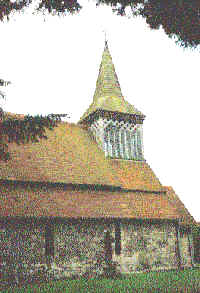
Set 440 feet above sea level this attractive old church has many features of interest notably the extremely narrow aisles in the nave, the hewn oak seats and the unusual and possibly unique tower; however there are many gaps in our knowledge of its history.
Empshott village is of course even older and its name is derived from the Old English word 'Imbe' or 'Ymbe' a swarm of bees and 'sceat' a grove or uncultivated woodland. A dozen variants of this name have been recorded including Imbeyte, Yuleshote and Imbishote but in 1098 it was as Hibeste that it merited its entry in the Domesday Book.
"Goisfrid the Marshal holds Hibesete of the king, and Bundi and Saxi held it of King Edward. It was then, as now, assessed at half a hide. Here is 1 ploughland, and 4 villeins with 1.5 ploughlands, a mill worth 50d, half a acre of meadow and woods for 1 hog. Its value was in the time o f King Edward, afterwards 20s, and now 30s."
The mill barely half a mile from the church is now known as Hawkley Mill and the Manor was probably where Grange Farm now stands 200 yards to the Northwest. The later history of the village is typical of many others in that there were 'not ten inhabited homesteads' after the Black Death in 1348. No similar information became available until 1665 when the Hearth Tax assessment showed that the parish had 69 hearths or about 45 dwellings, of which only a few still stand. The population was probably greatest in the late Victorian era but today the parish contains only about 100 adults in 50 homes.
That there was a Saxon settlement here suggests that it might have included a simple chapel but this is not proven. However there certainly was a chapel here by 1181 when Pope Alexander III confirmed at Southwick Priory (founded c. 1130) was in possession of 'the church of Portsea and the chapel of Yinbesieta'. That this possession was "confirmed" suggests that it could have been taken earlier but probably after 1163.
The church built between approximately 1187 and 1220 presumably with a Lady Chapel and a second chapel north of the chancel replaced the chapel (its dedication is not known). The finished church was dedicated to St. Lawrence and it continued as such until its connection with the Priory was severed on the latter's dissolution in 1537 as a consequence of Thomas Cromwell's reforms. There was considerable opposition to those reforms and this was organised as the "Petition of Grace" under the leadership of Robert Aske, a Yorkshireman, who also held the Manor of Empshott, but he was executed for treason in the same year.
Thereafter the church appears to have been neglected and fell into a state of grave disrepair until the 1620s when, probably at the instigation of the then Bishop of Winchester - Lancelot Andrews - it was restored - though not completely to its original form.
The most notable external changes were the addition of a bell tower at the west and the insertion of Jacobean style windows as shown in the eighteenth century drawing - which also reveals that the lady chapel was not rebuilt. Other changes almost certainly made were the addition of a porch west of the new tower and that the north chapel was not rebuilt.
Circa 1780 nothing is known about any structural changes which may have been made during the next 200 years. The churchwarden's accounts are only available from 1754 and initially are not helpful as they record only the costs of building materials and labour. Some of these costs were substantial in relation to the routine annual expenses - over five times the latter in 1754, seven times in 1783 and nine times in 1793. (Similar ratios of repair costs to routine expenditure have been recorded since 1945).
Later records are slightly more revealing for in 1838 'The church was repaired, several new windows opened, the screen restored, a cross erected on the Eastern Gable, texts of scriptures painted etc., etc., etc.," but the only relatively small costs recorded were for bricks.
Then, in 1859 "the tower and chancel were found to be in a dangerous condition" so the east wall of the chancel was repaired together with C4removing tower and securing roof to the body of the church".
However, seven years later several cracks had appeared in the newly repaired chancel wall and an independent survey noted many other serious faults and recommended, inter alia, that all of the walls of the chancel should be rebuilt and that the whole be re-roofed. This report initiated another major reconstruction and though the north and south chancel walls were not completely rebuilt they were buttressed externally and secured to the cast wall in which the Jacobean window was replaced by the present triplet - a memorial to William Scott. The church was completely re-roofed, that over the nave being raised above that of the chancel and the new internal timber made to a 15th century design. The south nave wall was also buttressed and a vestry and new tower were added to make the church as it appears today.
This work was completed in 1868 "at the sole expense of Mr Scott of Rotherfield Park". Later there was a special collection 'for the workmen" to which the major contributors were members of the Butler family who then owned the Manor and the Advowson. The resolution of thanks to Mr Scott for his generosity continued "... the substantial character of the work and its decorative effect reflects credit on those who have designed and executed it and affords magnificent satisfaction to the parishioners"
Much of this satisfaction was - and still is - inspired by the unusual and possibly unique tower designed by the architect Mr Pusey about whom nothing more is known, not even his initials. Although a much quoted record states that "the tower was restored in 1884 the cost was relatively small and probably only represented routine maintenance and its appearance was not altered. In 1897 a second bell was hung to commemorate the Diamond Jubilee of Queen Victoria.
The Interior
On entering the porch it is obvious that it too has been rebuilt, though when is not known, as its southern wall is very much thicker than the north one and each contains a much older Norman window. Around the inside of these windows several stones have been crudely inscribed with initials and dates - one of 1682.
These windows are not the only features, which are not in their original positions for another separates the porch from the nave, namely the chancel screen. The screen was moved to its present position either before or during the Victorian restoration when it was completely covered over on its nave side and fitted with an equally opaque door. This covering and the door were removed in 1987 when the present half glazed door and matching side panels were installed: T. Couzens & Sons of East Marden made them. The inscription over the door 'The gift of. 1624 James Meteaulfe' is surmounted by his family's coat of arms. Metcaulfe (or Metcalf) was another Yorkshireman who, like Aske, had been granted land in Hampshire, though not apparently the Manor of Empshott.
The nave has several features, which invite speculation. One is the extreme and impractical narrowness of the aisles, which are barely 2 feet 6 inches wide at waist height and less at floor level. Another is the small part of an arch on the south side of the east wall of the nave at the usual site for the entrance to a lady chapel; however this wall is not now wide enough to accommodate a complete arch. A third is that the southern arcade leans markedly outwards. Together these three features have given rise to the suggestion that the southern wall was resited to support the leaning arcade, and this supposition is apparently confirmed by the presence of the discharging arches which connect the top of each column to the wall. The proponents of this theory are divided about when the wall was resited, one view being that this was required very soon after the arcade was built. This view implies either that the south chapel was provided with another entrance (from the chancel or from the exterior) or that it was never completed. The alternative view is that the south chapel was built and the nave wall was resited later, probably during the Jacobean restoration.
The apparently conflicting opinion that the south wall is in its original position is not materially different from the first of these views. There is no incomplete arch on the north side of the nave wall to suggest that the north wall was resited and there are no discharging arches on this side indeed it has been suggested that those on the south are Victorian.
That both sides of the nave walls also appear to be leaning outwards is largely an illusion because they are much thicker at ground level.
The two arcades are far from identical, in that the span of their arches varies and especially in that the overall height of the southern columns is appreciably greater than those on the north, while there are many detailed differences in the decorative carving on both sides. Some of the bases appear to be replacements of a later design and the western responds are markedly different, the northern one bearing a carved head. The eastern responds also differ but both are unusual in that they are partly embedded in the wall of the nave. Conflicting opinions have been expressed about which arcade is the older but the most recent favour the southern.
Contrasting views have also been put forward to explain the unusual eastern responds - one being that the east nave wall was built primarily to reinforce them because there was an unforeseen movement of the arcade - as indeed occurred in the south side.
A second view is that the nave wall was built to reinforce the chancel wall and arch so as to support a bell tower and in this process inevitably surrounded the previously completed responds.
A third possibility, but with the same implications for the responds, is that the initial stimulus was aesthetic - namely to build the nave arch - and therefore also the nave wall to support it. Irrespective of why it was built, the resulting double wall is substantial, but whether the bell tower was ever built is yet another speculation.
The pews also vary in detail: many are based on massive 15th century hewn oak benches, the ends, backs and some of the rear shelves being later additions. A further modification was made in 1934 when 'after prayer and testing of the seats' the latter were made less uncomfortable by the addition of about three inches of oak to their forward edges.
The Victorian roof timbers are to a 15th century design and at the west some older beams remain visible.
The linenfold oak pulpit is presumably Jacobean and the carved font cover bears the date 1626 and the initials T.F. whose full name is not known. The font itself is of Purbeck stone, circa 1190 and is similar to several others in the country.
No two of the nave windows are identical -the southwest one is where there was previously a door. One of the adjacent double lights bears the mark a small wheatsheaf - of its Victorian designer, William Kemp.
The chancel windows also differ considerably - the Victorian east window has already been mentioned but the asymmetry of the other two is unusual. The small northern Norman window has been bizarrely reset inside another surmounted by a pointed arch visible from the exterior. Also in the north side is the blocked up arch, which presumably once led to a small chapel. Opposite this on the south wall is another Norman style arch with a smaller pointed arch inside it surrounding the door to the vestry: before the latter was built there was a door to the exterior in this position.
However the most important features of the chancel are its magnificent west arch and the Jacobean altar rails and choir stalls, the latter having three beautifully carved finials of primroses, ivy and oak leaves respectively: the fourth being a plain replacement.
The processional cross in the sanctuary was carved in 1987 by Miss Sue Haynes of Highbury and is a copy of a 12th century Italian crucifix now in the Victoria and Albert Museum. It was presented to the church by the then churchwarden, David Aston.
The churchyard contains only two gravestones from the eighteenth century - when the churchyard was very much smaller than it is today with its northern and eastern boundaries barely 10 yards from the church, though those on the west and south were in their present positions. The "waste land" between the church and the road was incorporated in 1863 but it was not until 1914 that the graveyard was enlarged to the east to about two thirds of its present extent, the remainder being added in 1944. The oldest yew tree, that on the north, was planted in 1829 on the boundary of the wasteland.
The Bells
There are two bells. Inscribed:
1st J. Warner & Sons Ltd., London 1897. (Dia. 19 inches 1/4")
Queen Victoria 1837-97. Jubilate.
G.H. Gotley, Vicar Empshott.
A. Christmas, W. Allam. - Churchwardens.
F. Carpenter & Son, Liss.
F. Carpenter & Son were wheelwrights in Liss who mounted this bell. "F' is thought to be a mistake for "N" (Noah Carpenter). Dr. Carpenter, lately Bishop of Oxford, was his grandson.
2nd Re-cast by Gillett & Johnston, Croydon, 1931. (Dia. 221/4") M (Monogram of Cyril F. Johnston the founder)
Original inscription reproduced thus - EK 1628.
E.K. is Ellis Knight of the famous firm of Reading bell-founders. Son of Henry Knight 1587-1622, Ellis I founded from 1623-1647.
The Registers
These are now in the care of the Hampshire Record Office at Winchester. The Baptism Registers date from 1718, Marriage Registers from 1722, and Burial Registers from 1772.
The first marriage register records that many, indeed most, were between couples from other parishes: this practice declined after 1753 when Lord Hardwicke's act tightened the requirements for the prior reading of Banns. Those changes are reflected in the next register entitled "Banns published and marriages solemnised 1754-1817". On the flyleaf of this book is a note -'The Parish Church of Empshott is called Holy Rood. Exactly when and why it acquired that name has still to be ascertained.
Envoi
The need to combat the ravages of time and weather is ever present and at the time of writing it is the tower, which needs repairing. The implication for so small a parish is obvious and any contribution from visitors will be thankfully received and faithfully applied.
OPD 1993