



|
|
|
Rowlands Castle
Upon entering the village from either the railway arches or Redhill Road, the eye is immediately drawn to the attractive variety of houses, cottages and shops surrounding the well cared for expanse of grass called 'the green'. Records show that in the 1750s local people were granted leave to build near the green and smallholdings and cottages began to appear. A booklet of around 1865 tells one to visit 'the handsome Almshouses on the Green at Rowlands Castle and see the small Inn, presumably the Fountain. The almshouses, called Stansted College, were built in 1850 to house six 'distressed gentlemen' and are now an attractive estate of some eight mews-style houses, not 'on the green' as we know it today. The "Castle" once stood to the East of the present-day centre of the village. Its' towers and battlements are known to have been in good repair in the twelfth century, when Henry II spent several days there in hunting and amusement. The Castle is thought to have lasted until the mid-fourteenth century, and in the nineteenth century a report states "the remains of Rowlands Castle consists of two masses of wall which are about 10 feet thick with a fosse of considerable depth".
The Parish of Rowlands Castle was formed in 1932 consisting of Blendworth Parish, Idsworth Parish (which had been attached to Chalton at one time) and parts of five other Parishes. One of these, Havant (Redhill), provided Rowlands Castle with a church, the Church of St. John, built about 1840 (registers date from 1841). The 'Castle Inn' was in the possession of the Outen family for 200 years, and was said to have been the headquarters of a notorious gang of smugglers.
Idsworth House was erected in 1852, in the Elizabethan style, and was the property of Lorna, Countess Howe. The ancient chapel of St. Hubert stands in the middle of a field, thought to be the site of a mediaeval village, on what was part of Idsworth Park. Parts of the chapel date from the twelfth century. The arrival of the railway line in 1858, and the building of the two arches to support it, changed the whole look of the village. Considered then to be ugly by many locals, the arches were built where the White Hart alehouse stood. This inn, the scene of the infamous murder of two Customs men in 1748, was knocked down about 1853, rebuilt on its present site and named 'The Castle Inn'.
The embankment holding the railway line runs over the site of the castle and nothing remains of its walls except two large fragments which fell into a deep chalk pit. Sad to say we are unable today to even see the remains of the grassy mounds that once used to form the motte and bailey castle that existed here. The ancient castle was supposed to have occupied the site of a Roman or Saxon entrenchment. It is said in one legend to have been built by a giant or 'forest free-booter' called Rowland.
The golf course was built in 1902 with only nine holes and was extended later to 18 holes and then again to championship length in 1969. At least two big events have been held there. It is still possible to live here and not require a car; both buses and trains serve the village and one can buy everything from the local shops. Today the green is nearly surrounded by houses and the population of the parish is around 2,500. Read about the Rowlands Castle Re-unions, CLICK the icons below:-
|
|
Send mail to
webmaster
with questions or comments about this web site. |

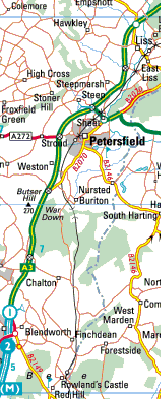 Nestling at
the end of a
beautiful
valley by
Chariton Down,
running from
Buriton,
Rowlands Castle
village is
indeed set in a
perfect spot
between the
ancient Forest
of Bere and the
entrance to
Stansted Park
on the edge of
the
Hampshire-Sussex
border.
Nestling at
the end of a
beautiful
valley by
Chariton Down,
running from
Buriton,
Rowlands Castle
village is
indeed set in a
perfect spot
between the
ancient Forest
of Bere and the
entrance to
Stansted Park
on the edge of
the
Hampshire-Sussex
border.