Hi Folks I'm Ted Douthwaite
- that's me below aged about 13/14 Patrol Leader in the Battersea Scouts (1936)
I went to Battersea Central from 1934 to 1937, gained a scholarship to School of Building (now part of the University of the South Bank) and was there when I went to Hawkley with my younger brothers Jack (11) and Cliff (7) on 1 Sept 1939.
On arrival at Petersfield we were mustered in a church and then put on buses, which conveyed us to Hawkley where we were given something to eat, and allocated to various homesteads in the village.
We three were taken to Oakshott Farm where Mrs. Martin the farmer's wife expressed much surprise since she was expecting three little girls and she got us three.
Jack and Cliff were soon involved with their schooling but I was at a bit of a loose end and helped on the farm with hop picking, mending fences, etc. and haymaking on another farm.
I remember the chap who drove the car with the hickory bars fitted on the front to gather the hay from in the field. His name was Dennis Bindon who was also about my age (16). My stay in Hawkley lasted only about four or five weeks as I had decided to return to Battersea to seek employment since Jack and Cliff had settled in at Oakshott Farm.
A very short stay, but if any of the class of Battersea Central of 1934, photograph and class register are given elsewhere on this website, would like to contact me they can do so through my brother Cliff who runs this website.
Me again left about 18/19 in the Royal Navy and below retired in 2002.
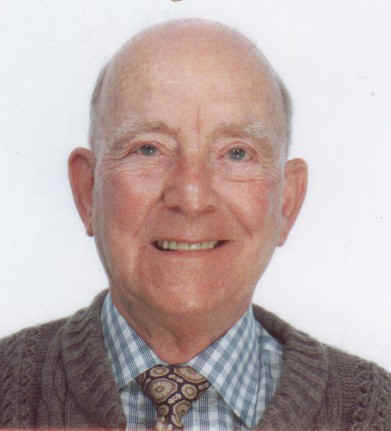
Afraid we have sad news, Ted Douthwaite died on Thursday 1st December 2005 at 1600, he had not been well lately and went into hospital in Edinburgh for tests and passed onwards suddenly.
May the Lord Bless him and keep him.
Edward Arthur (Ted) Douthwaite)
Edward Arthur (Ted Douthwaite) was born in 1923. His grandparents lived in Battersea, his grandfather being a painter and decorator. His father was and during the Second World War an Aircraft Progress Chaser. His mother worked at Walls Sausage Factory
Ted had one an older sister (Margaret) born in 1922, and three brothers, Robert (Bob) 1925 - 1996, Alfred (Jack) in 1928 and Clifford in 1932.
Like a large number of families between the Wars they moved on several occasions living in Amies St, St Andrews (now St Rule), Poyntz Rd, and Home Road.
Ted remembers that
‘Battersea was a rather grubby district caused mainly by a deposit of soot from the Morgan Crucible Company (which made carbon brushes for dynamos); many other factories in the area and from the variety of coal fired steam locomotives hauling goods and passenger trains through to Clapham Junction. But the houses were kept spotlessly clean and we were always well fed - nothing exotic but good plain nourishing food.
The milkman delivered to every household daily by handcart. Some milk was in bottles, some was measured out from the churn on the cart into pewter containers with handles, and hinged lids held by the householder. Bread was also delivered daily by handcart to every door - freshly baked crusty bread - it was not sliced in those days.
Ice cream vendors travelled the streets riding box tricycles Walls, Lyons and Eldorado 'Stop me and buy one' There was also an ice cream cart in Latchmere Road on the corner of the street leading to the swimming baths selling home-made ice cream - wafers and cornets one penny each or a small one for a halfpenny! At the sweet shop most loose sweets were 2 ounces a penny and were kept in glass jars on rows of shelves. When a jar was nearly empty the few sweets left were tipped into a jar of mixed remnants and sold for 4 ounces a penny. We watched this jar carefully! Favourites were Tiger nuts, Aniseed balls, Bullseye, and Acid drops (the girls liked Love Hearts and Parma Violets.
On Sunday mornings a vendor pushing a handcart and ringing a loud handbell announced "Straight off the boat" indicating that he was selling shrimps and winkles (by the pint). He was followed a little later by a turban-clad Indian ringing a small tinkling bell selling 'Indian Toffee' - which we now know as the fairground candy floss.
In the late 1920's when we were living in St Andrew Street (renamed St Rule Street just before the war) we often had a troupe of street entertainers who came with a barrel organ and drums, dressed as Egyptians and performed The Sand Dance after sprinkling some sand on the road. They also sang and danced to the sound of the barrel organ before passing round the hat.
In the early Thirties we would collect jam jars and beer bottles to return to the respective shops to collect the deposit cash and this would give us the necessary twopence to visit the cinema Saturday matinee. Cowboy heroes at that time were Buck Jones, Tim McCoy, William S Hart - all in silent films, the pianist at the front of the screen giving his all on the Overture to William Tell to give some atmosphere when the film reached the climax of the chase!’
Although Ted did not have continuity in elementary (primary) school education, as he changed schools according to where the family lived: Lavender Hill, St Andrews St, Grove Vale Dulwich, and Holden St schools. He does only vaguely remembers life at elementary school – ‘nothing outstanding’. He went to Battersea Central School from 1934 to 1937, which was ‘Interesting, but hard work.’
He was a member of the Wolf Cubs, Scouts, and then Rover Scouts.
He made use of Battersea Council’s swimming facilities. ‘Swimming good. Admission one old penny including a towel.’ He also remembers the Council Library as ‘good’.
Battersea Park was a ‘Very good escape from the streets’ It was ‘very well kept, the uniformed groundsmen in their brown kit were respected and obeyed immediately, they were the law!’
He visited South Kensington museums on some Saturdays.
He does not recall being aware of what the Council was doing, or of local political arguments, or of the local MP, or any of the elections of the time. His parents were not involved in any local organisations and activities.
Although he had left Battersea Central School in 1937, and was at the Brixton School of Building, he was evacuated to Hawkley to ensure that his brothers were okay.
His memory of changes during the War in Battersea were the air raid shelters. In 1942 he moved to New Malden
