



|
|
Mill House, Mill Lane. in 1939 part of the Hurst estate. Galleted malmstone with brick band and brick dressings. Slate roof. Diamond leaded casements in gable end. Present house dated 'R.W.H. 1774', but considerably altered. An inset stone bears an inscription giving details of the history of 'Hockeleye Mill'.
The entire parish of Hawkley has fine views westward with a skyline of hangers and extensive views north-east towards the Hogs Back. Different types of soils have produced a varied flora and fauna.
A dramatic event occurred at Hawkley in 1774: Gilbert White described how a large part of "the great woody hanger at Hawkley was torn from its place and fell down, leaving a high freestone cliff naked and bare, and resembling the steep cliff of a chalk pit." The second dramatic event occurred in 1939 when a party of London girls due to be billeted in Hawkley actually turnout to be BOYS. This must have been a shock to all those families with teenage girls. But perhaps to these maidens it was a gift from heaven? So in 1939 a section of Battersea Central School some of whom are shown below were locate within the village of Hawkley and that of Empshott
The boys and staff with their families were spread far and wide and some of the buildings indicated below became their new homes for up to three or more years. Mabbotts Farm, then one of the farms belonging to Mr. Clive Davies owner of Hawkley Hurst. 2 Timber-framed with malmstone filling. Upper storey tile hung. Thatched roof with windows at eaves level. Old central chimney. Walnut Cottage. Malmstone and brick with malmstone quoins. Tiles replace a thatched roof. Half-timbered wing with brick filling at rear. Old chimney. Hill Place, Empshott. Brick with some malmstone and plaster. Hipped tiled roof. Old central chimney. The porch section is an impressive feature ranging through 2 storeys, brick built with hipped tiled roof, with heavy wooden cornice. The doorway has heavy pediment of moulded and cut brickwork. A wide door is reached up a flight of five steps. The roof extends almost to ground level at rear. The kitchen contains a well with a large wheel. Mill Cottage, Mill Lane. Malmstone with plinth and raised flat band of maimrock between storeys. Tiled roof with central chimney. Casement windows. Was used as two cottages but now restored to the original single cottage. Over the door is written, '16 M 83 M E'. Nos. 1 and 2, Gardeners' Cottages, The Grange. Malmstone with brick dressings. Front refaced at later date, probably in C.18. Wing added to south. Sash and casement windows. Lower Green Farm. Date about 1760. Hipped tiled roof with two dormers. Frontage of brick, east wall malmstone with brick dressings with extension to north. West wall, malmstone, also with extension to north. The stable has been incorporated as part of the house. Parsons Piece. Galleted malmstone with brick dressings. Tiled roof. Casement windows. Timber porch with thatched gable. Brook Cottage. 2 storeys. Mairnrock with brick dressings. Hipped thatched roof. Gable end partly tile hung. Upper storey windows at eaves level. Cheesecomb Farm. Brick structure with tiled roof. Brick dentilled cornice and plinth. Brick porch. Casement windows surmounted by cambered arches. The rear of the house is of malmstone construction with brick dressings, and the roof descends to door level. A fireplace discovered during modernisation is thought to be C.14. Farewell Cottage. Originally two cottages now converted to one dwelling. 2 storeys. Brick with purple headers, on a plinth of malmrock. Tiled roof. Casement windows with glazing bars, those on ground floor with cambered arches. Lean-to at each end. The Old House, formerly Jolly Robin. Oldest end of C.17 or earlier with some timber-framing. 2 storeys. Mainly malmstone with brick dressings. Upper storey tile hung. Hipped tiled roof. Casement windows. More recent part to north of same structure.
Grange Farm Cottage, Empshott Green. Parts date from C.16. Timber-framed rear wing with brick dressings. Tile-hanging on frontage is modern. Tiled roof, central chimney. Some casement windows, leaded lights. West of Lower Green Farm. Converted from a stable in 1976. Malmstone with brick dressings. The original thatched roof has been tiled using old Slip Cottage and pond near Scotland Farm. Cottage built 1684 survived a 100 ft. subsidence together with its occupants on 28th March, 1784. 50 acres slipped including the pond and spring, which continued to run afterwards. A collection from over 2,000 sightseers was sufficient to repair and enlarge the cottage. Ref: Natural History of Selborne, (Gilbert White). Hawkley Hurst a grand house the property of Clive Davies, Squire of Hawkley.
|
|
Send mail to
webmaster
with questions or comments about this web site. |

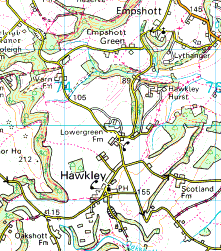 The
modern Parish
of Hawkley has
included the
small Parish of
Empshott since
1932. Hawkley
was not
recorded in the
Doomsday Survey
of 1086 as the
manor probably
formed part of
Newton Valence
with which
Hawkley was
closely
associated for
centuries.
The
modern Parish
of Hawkley has
included the
small Parish of
Empshott since
1932. Hawkley
was not
recorded in the
Doomsday Survey
of 1086 as the
manor probably
formed part of
Newton Valence
with which
Hawkley was
closely
associated for
centuries.
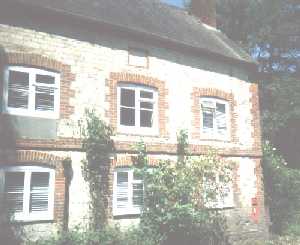 An old
cottage at
Lower Green was
originally mill
house of
Hawkley mill.
The ancient
mill belonged
to the Bishops
of Winchester,
was seized by
Adam Gordon but
given back by
Edward I in
1280. It was
later burnt
down, rebuilt
in 1774 and
used as a
cottage from
1882 onwards.
An old
cottage at
Lower Green was
originally mill
house of
Hawkley mill.
The ancient
mill belonged
to the Bishops
of Winchester,
was seized by
Adam Gordon but
given back by
Edward I in
1280. It was
later burnt
down, rebuilt
in 1774 and
used as a
cottage from
1882 onwards.
 The stream
behind the
house
originally
drove the
overshot wheel
of the mill.
Below a view of
the Mill in
2001 the wheel
and stream have
been converted
to a very
pleasant
garden.
The stream
behind the
house
originally
drove the
overshot wheel
of the mill.
Below a view of
the Mill in
2001 the wheel
and stream have
been converted
to a very
pleasant
garden.
 Primmers
Cottage,
Snailing Lane. Ironstone with
brick
dressings.
Tiled roof.
Some timber
work at north
end. Recently
renovated.
In the 1939
period Jim
Checkley (left)
states
the Cottage was derelict and used to be known by us as
'The Haunted
House
Primmers
Cottage,
Snailing Lane. Ironstone with
brick
dressings.
Tiled roof.
Some timber
work at north
end. Recently
renovated.
In the 1939
period Jim
Checkley (left)
states
the Cottage was derelict and used to be known by us as
'The Haunted
House