7 Arundel Road
Mitton
Tewkesbury
GL20 8AS
14 January 2007.
My name is Joan Attewell. (nee Pritchard)
In June 1940 my Father volunteered for the Army and enlisted in the Hampshire’s, No. 4 Commandos. Following the destruction of our home in Islington, London, and my Mother placed our belongings into store and we went to stay wherever my Father was stationed in Britain while he was training to go overseas.
Mother and I lived for short periods in Luton, Bournemouth, Boscombe, Seaford, Weymouth Largs and Fareham, where my Mother had obtained work as a parlour maid with the Bishop of Portsmouth’s household at Bishop’s Wood, but when Mother became pregnant we had to move again and we were found accommodation at Hawkley. We moved to Hawkley Hurst in June 1944, and as there was no transport from the station at Liss we walked into Hawkley village before we finally arrived at Hawkley Hurst. I well remember the hairpin bend, and the fact that the walk seemed to go on for ever! It was an extremely hot day and my Mother must have been exhausted, as she was 6 months pregnant at the time.
We originally lived on the top floor of the servants’ quarters, but some time after John’s birth (in September) we moved into the Buttery on the ground floor. Our living room had a door to the round tower, which linked the ground and top floors. Our bedrooms were actually the game larders, and our kitchen was originally the scullery - it had a communicating door to the main kitchen, and Mrs Davies would come through that way whenever she wanted to see my Mother, who helped Mrs Hudson with the cooking whenever Mrs Davies had visitors.
I started school in the infant’s section in the village hall (I was 6 years old), and subsequently moved to the main school. There were two classes, run by Miss Purdom (infants) and Miss Down (Juniors). Just before we left Hawkley I passed the scholarship and would have attended school in Petersfield, but in February 1948 we moved to Middlesex to be nearer to my Father’s place of work as commuting between Harrow and Hawkley each weekend was time-consuming for him and costly. I am not sure how I would have travelled to school, but I suppose in those days it would not have seemed unusual for a ten-year old to cycle 7 miles each way every day.
My memories of life at Hawkley School are very happy, despite the bucket lavatories in the school yard! The classes were small in number, (I believe that the total number of pupils was around 15) and there was ample incentive to learn. I still have a copy of The House of Golden Hind, given to me for good attendance, and most of my knowledge of natural history and the way of country life was learned either at school in Hawkley, or from Mrs Davies the wife of Clive Davies, while we were living at Hawkley Hurst. The school was very much involved with the activities of the village, and I remember learning the (apparently) extremely long words for the Empire Day, which I had the privilege of reading one year. The proximity to the Church meant that the schoolchildren including myself made up a significant part of the church choir. My brother was christened there by the Bishop of Portsmouth.
Mrs Davies took various sections of my education under her wing, and I was taken into the drawing room every Sunday afternoon, to learn how to draw and paint flowers and ladylike subjects. I am afraid I was a severe disappointment to her, as I have never had any talent in that sphere! One of my weekly tasks, for the payment of one penny, was to keep the large birdbath clean, and to this end I was encouraged to go into the garden room for brushes and watering cans.
I was allowed free access to the children’s playroom, with its wonderful library. My love of reading was nurtured here. Most of the well-known authors of children’s books were represented and the set of children’s encyclopaedias whetted my appetite for information of all sorts and I became quite a bookworm.
I remember the village shop, which was a wondrous place as far as I was concerned. It sold mainly food and hardware goods, but I do remember that the meat pies were sold in the post office (or was it the pub?). There was also an off licence, where we could buy ‘pop’, a bright pink liquid of unknown origin, but the best taste!
I remember a group of boys who came to Hawkley on a camping holiday and wonder if it was a group from Battersea? There was also a group of scouts who camped in the field near the lower gate one year. We were invited to one of their evening camp-fire ‘sing-songs’.
After the war was over Mrs Davies’ daughter and son-in-law came to live in Hawkley Hurst, and I played with their children, Mary-June and Rupert. Until then I had been the only child apart from my baby brother. Mary June was older than her brother, and went to boarding school, but Rupert and I became friends and enjoyed playing games involving tracking, climbing trees, wading in the stream, etc. As I was quite good at this type of activity I was allowed to become a member of his gang as an ‘honorary’ boy, and I became ‘Little John’ At holiday times there were other children who came to stay with Rupert’s family. Rupert eventually went to boarding school in Worcester.
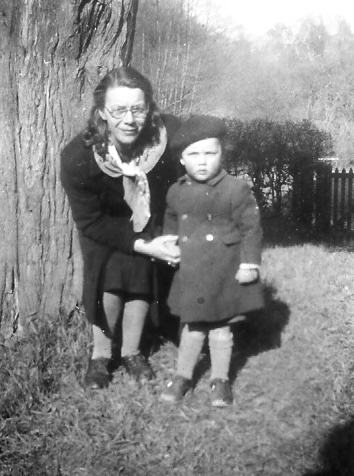
Mother and John
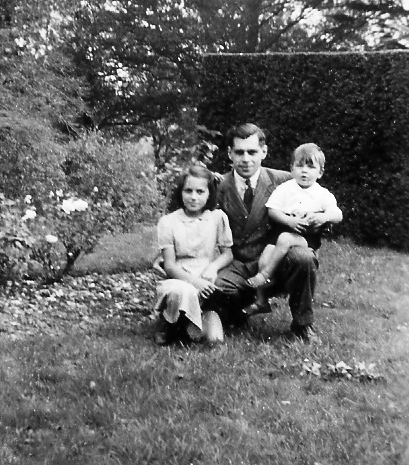
Joan, Father and John in the rose garden which was allocated for our use.
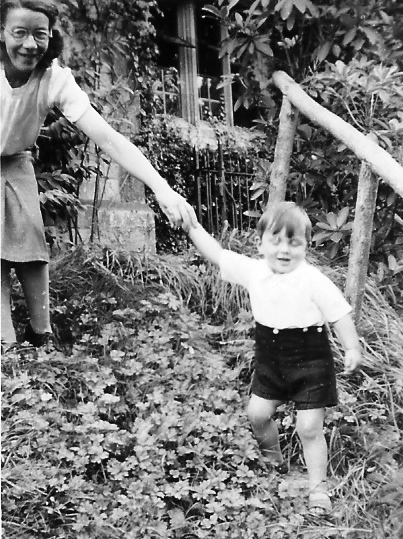
Mother, with John negotiating the steps into the rose garden.
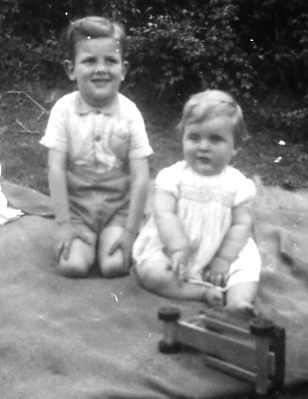
The two younger sons of Mrs Spurdle (David and John)
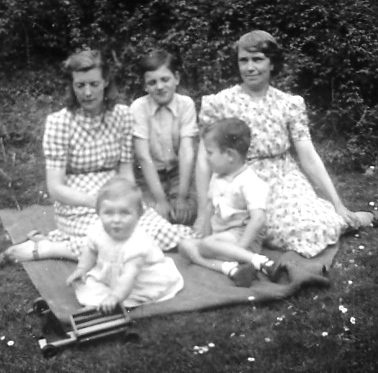
The Spurdle family (Mrs Spurdle, Michael and Gran, with John and David in front)
The photograph of Mrs Spurdle and her family was taken while they still lived at the Bothy, but later on they moved down to the mill. Michael and I used to walk to and from school until the momentous day when I was tall enough to be able to ride a bicycle. My Mother and I went to Liss for this purchase, and I learnt to ride properly on the journey home. (I had been practising on a bike which belonged to Mary June, but it was actually too large for me).
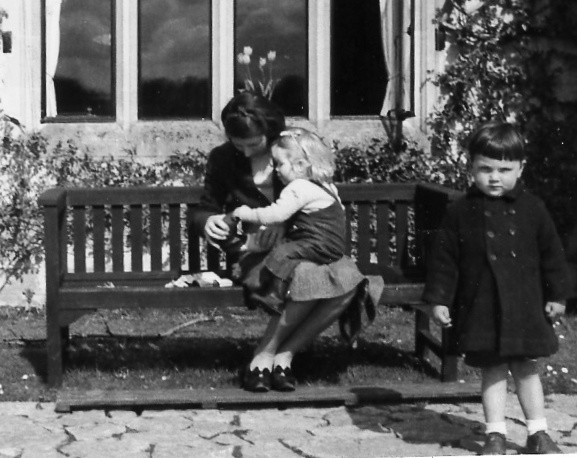
Mrs Wilkinson with Susan seated on the terrace. My brother John loved anything mechanical, and was probably fascinated by the camera!