



|
|
|
Battersea Comes To Hawkley From the dispersal point at Petersfield the Battersea Boys, Central School had to be absorbed by the surrounding villages. As the party included over 240 children, it was necessary to divide After consultations with the organising authorities, the original plan of three or more groups was dropped and the party was divided into two, one-third (80) going to Hawkley and two thirds to Rowlands Castle. The Hawkley party under the charge of Dr. Raine included Mrs. Raine, Mr. and Mrs. Alway, Mr. Forbes, Mr. and Mrs. King, Mr. and Mrs. Lewis, and Mr. and Mrs. Williams. After sitting in the Parish Church at Petersfield ** for a considerable time and being entertained by a pupil of the church organist who was practising the national anthem, three motor coaches were loaded with the Hawkley contingent and started off for their unknown destination. Having been introduced to Petersfield – it’s cinema, shops and other sights familiar to Londoners, they naturally thought it to be their billeting centre but as the journey proceeded and all modernity was left behind they began to wonder what was in store for them. **Although Charles Sammonds recall, that he and his brother George stood outside of the Methodist Church near the railway station and had nothing to eat until the evening meal, they were not issued with any goodies for their hostess, Charles has often wondered why they were treated differently.
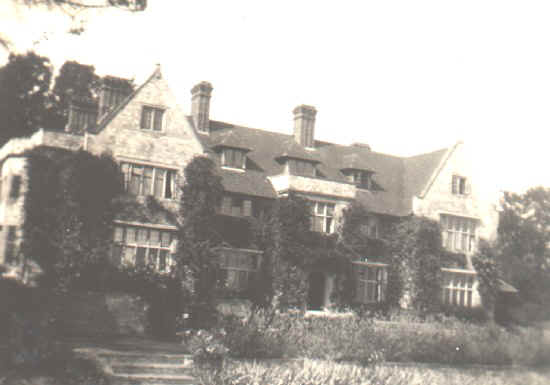
Their wonderment increased when one motorcoach failed to negotiate the hairpin bend on Hawkley Hill and had to make a second attempt eventually a church spire came into view and then a sure sign of habitation the 'Queen's Arms'. Soon afterward, the coaches stopped outside what appeared to be a small church hall but later they knew it to be the village school. The Village Evacuation Committee had made careful plans for the reception and billeting of the party but as they were expecting a junior girls school to arrive, they were greatly perturbed to see several lads, nearly six feet tall, descend from the coaches. The Age range of the school was 11 to 16 years but sisters and younger brothers some as young as five years were included in the party thus complicating the billeting problem. In the school, where the party assembled, Mr. and Mrs. Sutherland were expected to run a luggage office take over the bundles and suitcases, label each one and enter the names of all the children in a book. To attend to over one- hundred packages would have meant holding up the rest of the dispersal arrangements and as the evacuees were not young girls as expected the luggage went unchecked. In another part of the school building, Mrs. Scott was ready with three beds made-up to receive sick or weary ones. Outside the school, a boiler was ready with hot water whether the intention was to bath the whole party or the more nauseous, was never discovered! From the school, the party trooped across to the Institute where the thoughtful Committee had provided a substantial tea a welcome and very necessary item as the children had been traveling for seven hours. At this stage, the accompanying teachers had to retire into the background in some instances willingly and in others reluctantly while the chief billeting officer, Mr. Clive Davies the owner of Hawkley Hurst took charge.
Charles J Sammonds writes from Penn near Wolverhampton, West Midlands (he was billeted in Empshott) Dear Cliff, I promised Harry Withers the enclosed a long time ago, but have just managed to get round to transcribing the bits and pieces that Dick Raine (son of Dr Raine) gave me in July 1999, the last time I was able to attend the BCS evacuees' reunion. I started the reunions with only three of us (plus a couple of wives) in 1985, having kept in touch with my old billet hostess and her family from 1944 (when I was called up) until they all died off. It had built up to 12 to 15 when I handed the job over to Harry (ill health) in 1997, and you know what a marvelous job he has made of it since then! I was amazed, considering the regard we had for our Battersea Central School masters, that not one of the manuscript or typed lists was dated! The First September is easily identified for the Order of March, but the billeting List 1 had to deduce from what I knew of the lads and their billets at the time. Looking down the lists, I became a bit nostalgic! Daisy (William) Eastland was a good friend of mine (despite his crashing his Bike on its first day, and getting Johnny Yates into serious trouble) and I was sorry to learn that his house had been destroyed and that he had had to be rescued from the rubble. When my wife and I were down in Empshott in 1992 or so, we quite accidentally attended Peter Hassell's funeral. I was asked to give the address at Miss Allam's memorial service, and have been in touch with John Allam, her nephew, ever since. It turned out that he was at Churcher's College in Petersfield at the same time I was at Emanuel, which had been evacuated there. (Charles won a 13 plus exam to the grammar school Emanuel, but stayed in Empshott and cycled 7.5 miles to Petersfield and back each day) I must congratulate you on the hawkley web site - it is really extensive, and perhaps the only criticism I have is that there is little about the Empshott based evacuees and the Hut in which we did our afternoon classes and evening homework, (or played Monopoly!). A photo of the Holy Rood ** would be nice (the photo of Hawkley's church is very good). Incidentally, for over a year I wrote a monthly article for the Church Magazine on the subject of the evacuation, our behaviour, and its ramifications. I sent Harry about one year's efforts in case they proved of interest to the local papers. I also sent them to Mr. Wallower; the Petersfield Post features editor, but never found out if he used them! Well, congratulations again, and I trust that this year's reunion will be even better than previously. I am afraid that my health precludes my coming down, sadly.
**Webmasters note - there is already a picture of Holy Rood The lists generated by Charlie from documents obtained from Dick Raine are found here, just CLICK on the title, these are on white background and type is in black, suggest you print these to study at your leisure.
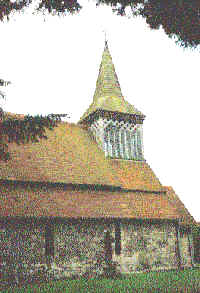
Left St Giles Church in Empshott Church of the Holy Rood, Empshott. 4-bay arcades with round and octagonal piers. Pointed arches with dogtooth hood moulds. Aisles with small lancet windows. Purbeck marble font. Victorian bell turret with spire. Ref: Buildings of England; Hants. and I.O.W., (Pevsner and Lloyd), pp.211-212. The tiny Parish of Empshott was distinguished in a survey of 1428 as one of the Hampshire Parishes in which there were fewer than ten inhabitants holding houses, in 1931 the population had risen to 171. The manor of Empshott belonged to Edward the Confessor but was leased to Bundi and Saxi; at the time of the Domesday Survey it was held by Geoffrey de Venuz, a marshall to William the Conqueror. The manor remained in the Venuz family during the twelfth and thirteenth centuries but by the reign of Edward II it had passed to Aymer de Valence. Grange Farm was originally the manor house, and the manor courts were always held there. Then followed a time of inactivity with no schooling or place of assembly the school staff meeting in the cart shed at Jolly Robins for want of a better places
The London children were at first bewildered in their strange, surroundings. All their lives they had taken for granted the roar of the traffic, the jostling crowd and the quick tempo of town life. Having no school activities and with much leisure time on their hands the feeling of homesickness was accentuated and a few quickly returned to Battersea. The remainder soon found much to interest them but their ignorance was sometimes responsible for conduct that offended the countrymen. They could not understand why so much importance was attached to the closing of a field gate or the sin of breaking through a hedge. Of course from the time of their arrival their conduct was viewed with suspicion and mistrust by those, who have a natural antipathy towards townsmen and it was not long before all childish misdemeanors were attributed to the evacuees. The servile attitude in evidence among some country people was lacking in the Londoner. For instance the drivers of large private cars were most annoyed when they encountered children in the country lanes who would not immediately rush to the ditch to give them a clear road The Londoner had been used to a pavement and now that the pavement was missing they assumed that the whole road was a pavement. Looking back now over a lengthy period of evacuation one is gratified to recall the many instances of unstinted devotion shown towards these little 'foreigners'.
Doris Barber remembers when the Battersea Boys were in the village on the whole they fitted it very well, as it must have been a whole new world to them - such as learning to milk a cows, haymaking, potatoes picking and hop picking. Hawkley School was taken over- by Battersea Central and the Hawkley children plus the younger brothers of the Battersea Central Boys had two classes in the old Village Hall, Dr. Raine was Headmaster of the Battersea Boys and lived in Parsons Piece. Two of the Phillips brothers was billeted with Mrs. Hodson who lived in Rose Cottage now Walnut Tree Cottage - in those days, it was two cottages. Mr. & Mrs. Kemp lived next door and their daughter Jean married Peter Croft who was a Battersea Boy billeted at Froxfield - and later came to work at Tubbs Farm.
(left)The young James Checkley please note the smart attire with tie, even for cycling, BCS had a standard. Jim writes in 2002 :- "I think I was about 15. In those days we stayed in short trousers much longer than they do today. Don't forget that the more material that was used the more clothing coupons were needed so short trousers were more economical. It would not do for the youngsters of today who seem to be in long trousers in Infant School."
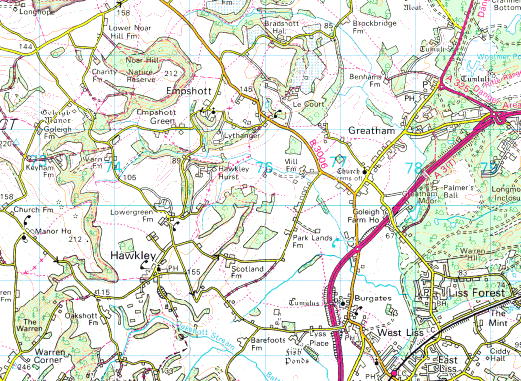
Jim Checkley also writes "Doug G.Lewis was billeted in Snailing Lane with Mr. & Mrs. Legge. Mr. Legge was the Local Builder and my host, Len Waghorn, was his Foreman. The house you lived in (Tom Cowell) was built by Legge during the recession to keep his men employed. You lived with The Potters, the Eatons were next door. Can you remember the names of the occupants of the other two houses in the Parklands Block? Fred Wakeling was billeted with Lady Baring in the house beside Empshott Church. He was a particular chum of mine and we did keep in touch after I left in 1943. He was Godfather to my first son who was born in 1948. We kept in touch until the mid 50's when contact was lost. I have not heard from him since. Another name mentioned was Arthur Govus, my brother, Bill married Arthur's sister Joan in 1951 or thereabouts. I am still in contact with Arthur and have taken him to the last couple of Re-unions, along with, Bob Blackie & Stan Creed, in my car. All being well we will be going together again this year 2002. My wife's name is Jeanne and we married in 1946. Good Luck & Best Wishes, Jim"
As a Battersea schoolboy, I should have remembered the borough coat of arms, or should it be borough seal. The words were something to the effect of - non mihi non tibi sed nobis This translated means not mine not thine but ours. These seemed particularly appropriate for a Labour constituency represented in the old days by Douglas Jay-the elder. (These comments were with reference to the web site which the webmaster pointed out it was OUR site not his!) Historically, I was not with the early evacuees party; I was on holiday in Suffolk during the outbreak of war and went to school there for six months. When I rejoined Battersea Central School at Hawkley I was with a family named Potter in Snailing Lane, the head of this house was a corporal in the Royal Engineers . Whilst the Checkley's were next door and Doug Lewis boarded a few houses down the road his host was a plumber/builder. Later I went to the Hurst and stayed there until I went into the army. I went to Greatham church and was confirmed there by the Bishop of Portsmouth. Since those day and my move to Canada in 1955 I have carried on correspondence with Charlie Sammonds (on and off) for the last forty odd years. Arthur Govus was our best man for my wedding although his writing skills are not his strong point. Communication is limited to a card at Christmas. My writing has suffered by living in a Canadian culture where you pick up the telephone. As you probably know, once we have paid our telephone line charge (like the USA) there are no charges for local calls. My children grew up in an environment where they picked up the telephone to call a friend across the street and it did not really matter if they chatted for half an hour. It is also another reason why Internet providers are inexpensive. Yes we are in still in Canada and have been since 1955, No, I will not be at the 2002 reunion. The timing is off for us in July. We stay close to home because the summers are so short fifteen centimetres snow on April 28 this year, and we cannot plant outdoors until May 24th to avoid the risk of late frost. By the end of August, the vegetation starts to die off. I will consult the site regularly. Congratulations it's nicely done. Tom
|
|
Send mail to
webmaster
with questions or comments about this web site. |

 On one
occasion when an
evacuee was
transferred to.
Hawkley Hurst
he exclaimed on
seeing the
butler open the
door,
"Blimey!
They got men
waitresses!"
On one
occasion when an
evacuee was
transferred to.
Hawkley Hurst
he exclaimed on
seeing the
butler open the
door,
"Blimey!
They got men
waitresses!"
 Jim Checkley
was with the
Waghorns at the
end of Snailing
Lane. In
addition, more
evacuees were
at
Jim Checkley
was with the
Waghorns at the
end of Snailing
Lane. In
addition, more
evacuees were
at 